

SIP Trunking Trends for 2026: AI, Security, and Global Scale
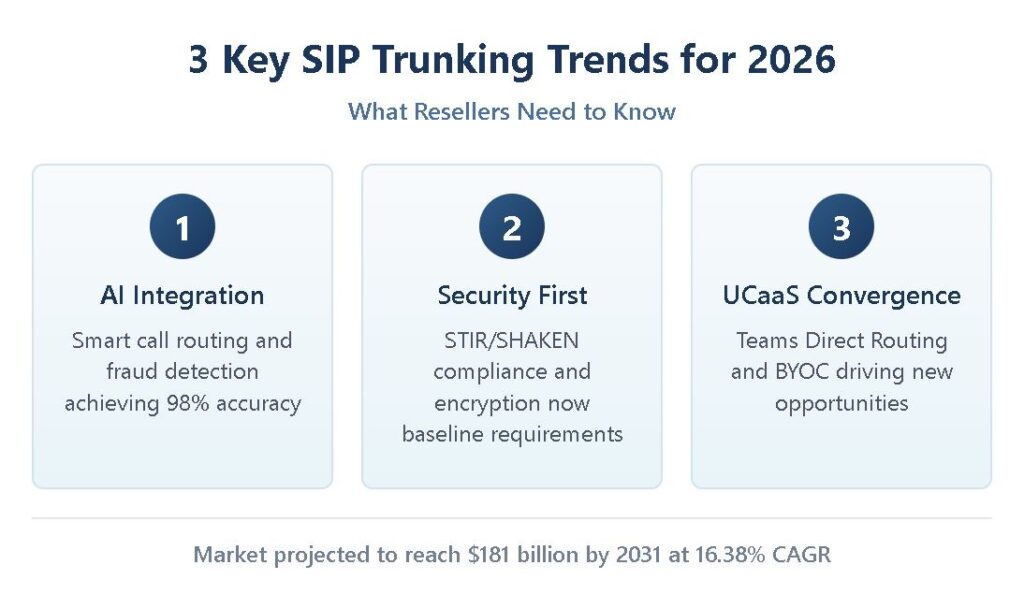
The SIP trunking market is accelerating toward $181 billion by 2031, driven by AI integration, enhanced security protocols, and unified communications. For telecom resellers, 2026 is a pivotal moment to differentiate through emerging capabilities.
- AI-powered call routing and fraud detection are becoming baseline expectations, with machine learning achieving up to 98% accuracy in threat identification.
- Updated STIR/SHAKEN compliance requirements and encryption standards are creating new value propositions for security-focused resellers.
- Microsoft Teams Direct Routing and UCaaS platform integration have moved from premium features to standard service requirements.
Resellers who position themselves as experts in these emerging trends will capture disproportionate market share as businesses modernize their communications infrastructure.
The telecommunications industry rarely stands still, but the pace of change in SIP trunking has accelerated. Current VoIP trends indicate that organizations are embracing intelligent, integrated communication systems. What began as a cost-saving alternative to traditional PRI lines has evolved into the foundation of modern business communications. The SIP trunking market is projected to grow from $85.07 billion in 2026 to $181.58 billion by 2031, representing a compound annual growth rate of 16.38%.
For telecom resellers, VARs, and managed service providers, understanding these SIP trunking trends for 2026 opens up concrete opportunities to expand service offerings, deepen client relationships, and build sustainable recurring revenue streams. The resellers who recognize these patterns early and adapt their strategies accordingly will find themselves well-positioned as trusted advisors to businesses.
This analysis examines the technologies, regulations, and market forces that will define SIP trunking in 2026 and beyond, with particular attention to what these changes mean for reseller business models and client conversations. Understanding the SIP technology future helps resellers prepare their offerings and conversations accordingly.
What’s Driving SIP Trunking Trends in 2026?
Several factors are propelling the SIP trunking market forward. Understanding these drivers helps resellers articulate value to prospects and identify the most receptive market segments.
The retirement of legacy PSTN infrastructure continues to accelerate. Telecommunications carriers worldwide are decommissioning copper-based systems, leaving businesses with little choice but to migrate to IP-based solutions. This mandatory transition creates a natural sales opportunity for resellers who can guide clients through the process with minimal disruption.
Remote and hybrid work arrangements have become permanent fixtures. Organizations need communication systems that function seamlessly regardless of where employees are located. SIP trunking enables this flexibility by decoupling voice services from physical locations, allowing workers to maintain a professional phone presence from any internet-connected location.
Cost optimization remains a powerful motivator, particularly for organizations with high call volumes or extensive communication needs. Businesses migrating from traditional circuits typically realize savings between 25% and 65%, with the most dramatic reductions occurring on international traffic where SIP eliminates dedicated access lines and enables dynamic least-cost routing.
The small and medium business segment is expanding at the fastest rate, driven by cloud solutions that eliminate the need for on-premise infrastructure. These organizations can now access enterprise-grade communication capabilities without enterprise-level capital expenditures, creating opportunities for resellers who can simplify the technology selection and implementation process.
How Is AI Transforming SIP Trunk Services?
Artificial intelligence is now an essential capability in SIP trunking platforms. This SIP innovation is reshaping everything from call handling to security, creating new value propositions for resellers and their clients.

AI-Powered Call Routing and Analytics
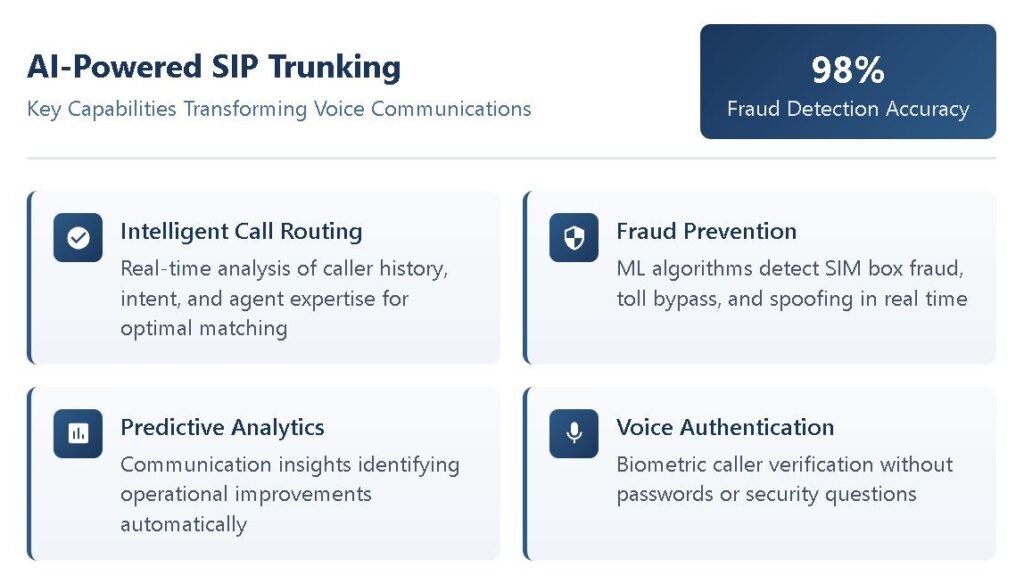
Traditional call routing operates on static rules: time of day, caller input, or simple round-robin distribution. AI-powered routing, on the other hand, analyzes multiple data points in real time to determine the best path for each interaction.
Modern systems evaluate caller history, inferred intent from speech patterns, agent expertise, and current workload distribution to make routing decisions that improve first-call resolution rates and customer satisfaction. When integrated with CRM platforms, these systems can pull account information and previous interaction notes before the call reaches any human agent, enabling personalized service from the first moment of contact.
The analytics capabilities are equally transformative. AI-driven systems provide actionable insights into communication patterns, identifying opportunities for operational improvement that would be impossible to detect through manual analysis. Resellers who can help clients interpret and act on this data position themselves as strategic partners rather than commodity suppliers.
Fraud Detection and Threat Prevention
A major topic surrounding VoIP trends focuses on security concerns that have historically limited SIP adoption in certain sectors. AI-powered fraud detection provides protection that exceeds what traditional security measures can achieve.
Machine learning algorithms continuously analyze call patterns, establishing baseline behavior for each account and flagging anomalies that might indicate fraudulent activity. These systems excel at identifying sophisticated threats like SIM box fraud, toll bypass schemes, and international rate pumping that would evade rule-based detection methods. Industry implementations have demonstrated accuracy rates approaching 98% in identifying fraudulent calls before they generate significant charges.
Voice authentication adds another security layer, using biometric analysis to verify caller identity without requiring passwords or PINs. This capability is valuable for financial services, healthcare, and other sectors where caller verification is essential. For resellers, the ability to offer advanced security features differentiates their services and justifies premium positioning.
What Security Advancements Should Resellers Prioritize?
Security has evolved from a technical checkbox to a primary purchasing criterion for SIP trunking services. SIP security concerns now drive purchasing decisions at the executive level, particularly in regulated industries.
STIR/SHAKEN Compliance Evolution
The FCC’s enhanced STIR/SHAKEN requirements, which took effect in 2025, eliminated previous workarounds that allowed providers to rely on third-party authentication services. Every provider with STIR/SHAKEN obligations must now obtain and use their own certificates directly from approved authorities.
These changes have practical implications for SIP trunking compliance that resellers must understand. Providers can no longer defer to downstream carriers for determining call authenticity levels. Each must independently evaluate every call and assign appropriate attestation levels based on their own analysis and customer relationships.
For resellers, compliance expertise is a competitive advantage. Businesses are increasingly concerned about regulatory requirements they don’t fully understand. A reseller who can explain STIR/SHAKEN implications, verify that wholesale providers meet current standards, and document compliance for client audits provides genuine value that commodity providers can’t match.
Encryption Standards and Zero-Trust Architecture
SIP trunk encryption operates on two independent layers: Transport Layer Security (TLS) for signaling and Secure Real-time Transport Protocol (SRTP) for media. Both are necessary for comprehensive protection, yet many implementations still default to unencrypted transmission unless specifically configured otherwise.
For enterprise deployments, mutual TLS (mTLS) is the gold standard. Both endpoints authenticate each other during the handshake, preventing unauthorized SIP endpoints from initiating sessions. This approach adds verification that ensures only registered, certificate-trusted systems can exchange signaling and media traffic.
Zero-trust architecture principles are increasingly applied to voice communications. Rather than assuming that traffic inside the network perimeter is trustworthy, these frameworks verify every connection regardless of origin. Session border controllers functioning as specialized firewalls for SIP traffic identify and block suspicious patterns indicating fraud attempts or denial of service attacks. Resellers who can implement and explain these security measures address concerns that often delay purchasing decisions.
How Is UCaaS Integration Reshaping SIP Trunking?
The boundaries between SIP trunking and unified communications platforms have largely dissolved. What were once separate product categories are converging into integrated solutions that combine voice, video, messaging, and collaboration capabilities.
Microsoft Teams Direct Routing has become a prominent integration point. Organizations that have invested heavily in Microsoft 365 environments want to leverage their existing infrastructure for voice communications rather than maintaining separate systems. Direct Routing uses SIP trunks to connect Teams to the public switched telephone network, allowing users to make and receive external calls directly within the Teams application.
This integration creates opportunities for resellers who can serve as the bridge between Microsoft’s platform and carrier connectivity. The technical requirements for Direct Routing include session border controllers, properly configured SIP trunks, and expertise in both Microsoft administration and telecommunications provisioning. Many organizations lack this combination of skills internally, creating demand for partners who can deliver turnkey solutions.
The Bring Your Own Carrier (BYOC) model has expanded as organizations seek flexibility in their UCaaS deployments. Rather than accepting bundled voice services from their collaboration platform vendor, businesses are separating carrier selection from application choice. This separation gives them leverage to negotiate better rates and maintains continuity if they switch platforms in the future. For SIP trunking resellers, BYOC presents an opportunity to provide voice services to organizations already committed to specific UCaaS platforms.
What Role Will 5G and Edge Computing Play?
The rollout of 5G networks is influencing SIP trunking by enabling faster, more reliable communication. Providers are adapting to support the higher bandwidth and lower latency that 5G offers, enhancing the quality of voice and video communications.
Edge computing complements 5G by processing data closer to where it is generated. Voice communications benefit from reduced latency and improved call quality, particularly for organizations with geographically distributed operations. The combination supports advanced applications such as IoT integration and real-time data processing that benefit from increased speed and capacity.
WebRTC integration enables direct browser-to-PSTN calling without traditional SIP clients, expanding accessibility and simplifying the development of custom communication applications. Users can connect from browsers or softphones without sacrificing PBX features, creating seamless voice experiences across devices and locations. This trend benefits organizations supporting remote workers who may not have access to dedicated desk phones.
For resellers, these infrastructure improvements translate into better service quality and new use cases to discuss with clients. Organizations that previously dismissed VoIP due to quality concerns may be ready to reconsider as underlying network capabilities improve.
Top SIP Trunking Trends Resellers Should Watch in 2026
The following developments represent the SIP technology future, creating opportunities and challenges for telecom resellers in the coming year:
- AI-driven customer experience enhancement: Clients increasingly expect intelligent call handling, automated transcription, and sentiment analysis as standard features rather than premium add-ons. Resellers should evaluate their providers’ AI roadmaps and be prepared to demonstrate these capabilities.
- Proactive security and compliance positioning: Rather than treating security as a cost center, forward-thinking resellers are positioning compliance expertise as a value driver. The ability to navigate STIR/SHAKEN requirements, implement encryption, and document security measures for audits differentiates premium providers.
- UCaaS platform partnerships: Developing expertise in Microsoft Teams Direct Routing, Zoom Phone, and other major platforms opens doors to organizations that have already made UCaaS commitments. These clients need SIP trunking partners who understand their chosen environment.
- Flexible pricing models: The market is moving toward consumption-based pricing that aligns costs with actual usage. Resellers who can offer metered, unlimited, and hybrid options accommodate diverse client needs and capture business that might otherwise go to more flexible competitors.
- Disaster recovery and business continuity focus: Organizations are prioritizing communication resilience following disruptions that exposed vulnerabilities in traditional systems. SIP trunking’s inherent flexibility enables automatic failover to backup numbers, geographic redundancy, and rapid recovery capabilities that resonate with risk-conscious buyers.
Frequently Asked Questions
What is the biggest SIP trunking trend for 2026?
AI integration is the most transformative SIP innovation in 2026. Machine learning capabilities are enhancing virtually every aspect of voice communications, from intelligent call routing that matches callers with optimal agents to fraud detection systems that identify threats in real time. Organizations that adopt AI-enhanced SIP services gain measurable advantages in customer experience and operational efficiency.
How does AI improve SIP trunk security?
AI improves SIP security through continuous pattern analysis that identifies anomalies human monitors would miss. Machine learning algorithms establish baseline behavior for each account, then flag deviations that might indicate fraudulent activity. These systems detect sophisticated threats with accuracy rates that exceed traditional rule-based detection. Voice biometric authentication verifies caller identity without relying on passwords or security questions.
Why is STIR/SHAKEN compliance important for resellers?
STIR/SHAKEN compliance is important for resellers because it directly affects call completion rates and client trust. Calls from non-compliant sources are increasingly blocked or labeled as potential spam, damaging business communications. Resellers who partner with fully compliant wholesale providers protect their clients from these issues. Additionally, compliance expertise positions resellers as knowledgeable advisors who can navigate complex regulatory requirements on behalf of clients who lack telecommunications expertise.
Position Your Reseller Business for 2026 Success
The SIP trunking trends for 2026 point toward a market that rewards expertise, security consciousness, and adaptability. Resellers who invest in understanding AI capabilities, compliance requirements, and platform integrations will find themselves well-positioned to capture business from organizations seeking knowledgeable partners.
As SIP technology becomes more sophisticated, clients need guidance on selecting appropriate features, implementing security measures, and integrating voice with their broader technology stack. Resellers who can deliver this consultative value build relationships that generate recurring revenue and resist competitive pressure.
SIPTRUNK provides a comprehensive reseller platform that enables telecom professionals to capitalize on these market trends. With compliance support, technical resources, and a dealer-focused approach, SIPTRUNK equips resellers to deliver enterprise-grade SIP trunking services while building sustainable businesses. Get started today and position your reseller business to thrive in 2026 and beyond.

Mitch leads the Sales team at BCM One, overseeing revenue growth through cloud voice services across brands like SIPTRUNK, SIP.US, and Flowroute. With a focus on partner enablement and customer success, he helps businesses identify the right communication solutions within BCM One’s extensive portfolio. Mitch brings years of experience in channel sales and cloud-based telecom to every conversation.